This week felt like a compressed preview of the future of work.
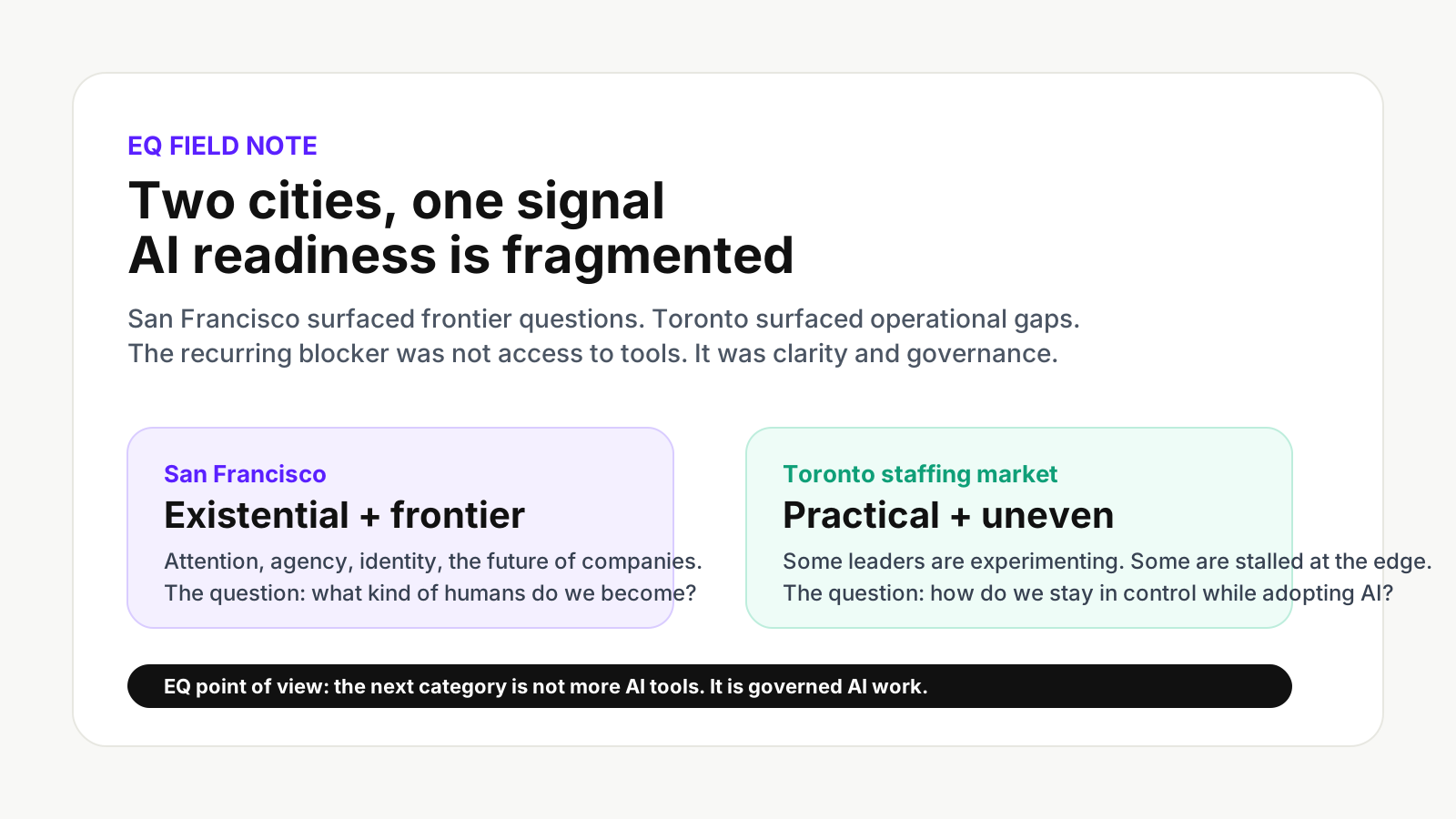
In San Francisco, the dominant conversation was existential. In Toronto, it was operational. Different rooms, different language, different urgency. But both cities kept pointing to the same conclusion: most companies do not need more AI tools. They need clearer systems for how work should actually get done.
Two cities, two operating systems
In San Francisco, the signal was density.
Within a single week, it was possible to move from a driverless car into Human Tech Week, into conversations with frontier operators, product leaders, and investors asking the biggest version of the question: what is AI doing to human agency, attention, identity, and the future shape of companies?
The atmosphere in SF was not about whether AI is real. That debate is over. The real conversation was about what kind of humans and organizations we become if these systems continue to compound.
Toronto surfaced the other side of the same story.
After a four-hour delay and a 1am arrival, I gave a Zero-Admin keynote the next day at a staffing conference. The room was less philosophical and much more uneven.
Some leaders were already seeing wins and wanted more. Some could not understand why more peers were not experimenting yet. Others were still at the starting line, openly saying they did not yet understand AI well enough to lead the conversation themselves.
That spread matters. It suggests we are not moving through a clean adoption curve. We are moving through a fragmented one.
The blocker is usually not the technology
Across both cities, the same pattern kept showing up.
The constraint is usually not access to models, copilots, or automation tools. The constraint is clarity. Teams do not know what should be automated, what should stay human, what should be logged, where authority sits, or how to keep control once systems start acting.
That is why one of the most resonant lines of the week was simple: no more tools.
Not because software does not matter. It does. But most teams are already overloaded with tabs, dashboards, and disconnected assistants. Adding another surface rarely solves the operating problem. The real opportunity is to get agents to do useful work inside a governed system.
That is the lens behind EQ Workers and the broader Zero-Admin thesis. The goal is not to pile more software on a team. The goal is to build an agentic workforce that operates with policy, auditability, and real business usefulness.
Why this matters more in staffing
The staffing market makes this gap easier to see because the work is already high-pressure, operationally dense, and human-dependent.
Recruiters, operators, and leaders are trying to protect trust while moving faster. They are balancing candidate experience, client expectations, internal visibility, and margin pressure. In that environment, generic AI tooling creates as much risk as upside if nobody can explain how the work is being governed.
That is why the real customer questions are usually not technical.
They are operational:
- How do we stay in control?
- What can the system do alone?
- What needs review?
- What gets logged?
- How do we make this useful in a real business, not just impressive in a demo?
Those are good questions. They are the questions that turn automation into operations.
The human layer got more important, not less
One of the strongest signals of the week was that progress still came through human warmth.
The best moments did not feel like abstract AI wins. They felt like trust wins, timing wins, relationship wins, and judgment wins. Good conversations still matter. Conviction still matters. Keeping your word still matters.
As systems get stronger, that human layer does not disappear. It becomes more valuable.
Business is still about trust. In many cases, trust may become the scarcest advantage because more of the underlying capability is being commoditized.
Soft skills are becoming hard infrastructure
Another recurring theme was the growing mismatch between formal education and the real operating environment people are entering.
In conversations about the skills crisis, one idea that stood out was the need for a kind of white-collar apprenticeship: a more practical bridge between school and the actual demands of modern knowledge work.
That feels directionally right.
If AI increasingly runs on language, then communication quality, reading comprehension, judgment, adaptability, and integrity stop being “soft” extras. They become core infrastructure.
The people who win in this environment will not just be the ones with access to better tools. They will be the ones who can combine judgment, communication, trust, and execution in a world where capability is abundant but clarity is scarce.
Fear is shaping the market too
Not all signals this week were encouraging.
Disruption is surfacing innovation, but it is also surfacing fear. Fear of being left behind. Fear of losing control. Fear of no longer knowing what a good career looks like. Fear that the rules changed before people had time to understand the game.
That fear showed up plainly in staffing conversations. One CEO summarized the conference mood in a sentence: people are scared of AI.
That reads as true.
And if that is true, then the category opportunity is not just raw capability. It is governed adoption.
The next category is governed AI work
I left the week with more questions than answers, but one conclusion felt stable.
The next category is not more AI.
It is governed AI work.
That means systems with clear roles, review rules, logging, ownership, and practical value inside real operating environments. It means helping companies adopt AI without surrendering control. It means building tools that disappear into useful work rather than adding more noise.
That is where EQ fits.
What operators should do now
If you are leading a staffing or recruiting business, the move is not to chase every new tool release.
Start smaller and govern better.
- Pick one workflow with clear pain and measurable output.
- Decide what the system can do alone and what requires review.
- Define where actions get logged.
- Protect the human moments that create trust.
- Build from one governed loop, not a pile of disconnected experiments.
That is how companies turn AI from ambient anxiety into operational advantage.
If you want help mapping that first governed loop, EQ is opening workflow audits for teams that want to move without losing control.