Staffing buyers already ask AI tools questions you care about:
- “What’s a normal markup for IT staffing?”
- “How do staffing agencies price contract roles?”
- “Contingency vs retained search — what’s the difference?”
- “How long does it take to fill a nurse role?”
If the AI answer is the first (or only) touchpoint, you win when your agency becomes the source that gets reused and quoted.
That is AEO.
What is AEO (in two sentences)
Answer Engine Optimization (AEO) is creating clear, verifiable, well-structured answers that AI answer engines can confidently reuse. It’s not just ranking a blog post — it’s becoming the reference a buyer sees when they ask a question.
Why AEO matters now for staffing agencies
Traditional SEO assumed a click.
AEO assumes many searches end without a click because the answer shows up in ChatGPT, Gemini, Perplexity, or Google AI Overviews. When that happens, the “winner” is the brand that looks most reusable:
- direct answers up front (no fluff)
- specific ranges and context (not vague claims)
- consistent definitions across pages
- credible process and examples
For staffing agencies, this is a real advantage. You sell a high-trust, high-variance service. The agency that becomes the most reliable source of truth in a niche tends to win higher-intent inbound.
The AEO playbook (staffing-agency version)
Step 1: Build the “20 money questions” list
Pick 20 questions that are actually asked by buyers (hiring managers, HR, procurement, founders). If your team hears it on calls, it counts.
Start with these and swap in your niche:
- What is a typical markup for IT staffing?
- What’s the difference between bill rate and pay rate?
- What is a fair contract-to-hire conversion fee?
- How do staffing agencies price direct-hire?
- What’s the difference between contingency and retained search?
- How long does it take to fill roles in {specialty}?
- What should be in a staffing agency MSA?
- How do we budget for contractors vs FTE?
- What’s the best way to reduce time-to-fill without sacrificing quality?
Rule: each question must connect to money (pricing, risk, speed, compliance, quality).
Step 2: Create one “answer page” per question
Each question gets its own page.
Do not bury the answer under a long intro. Answer engines reward pages that:
- lead with a direct answer (2–5 sentences)
- define key terms
- give a range (with context)
- show a simple example calculation
- list what changes the answer
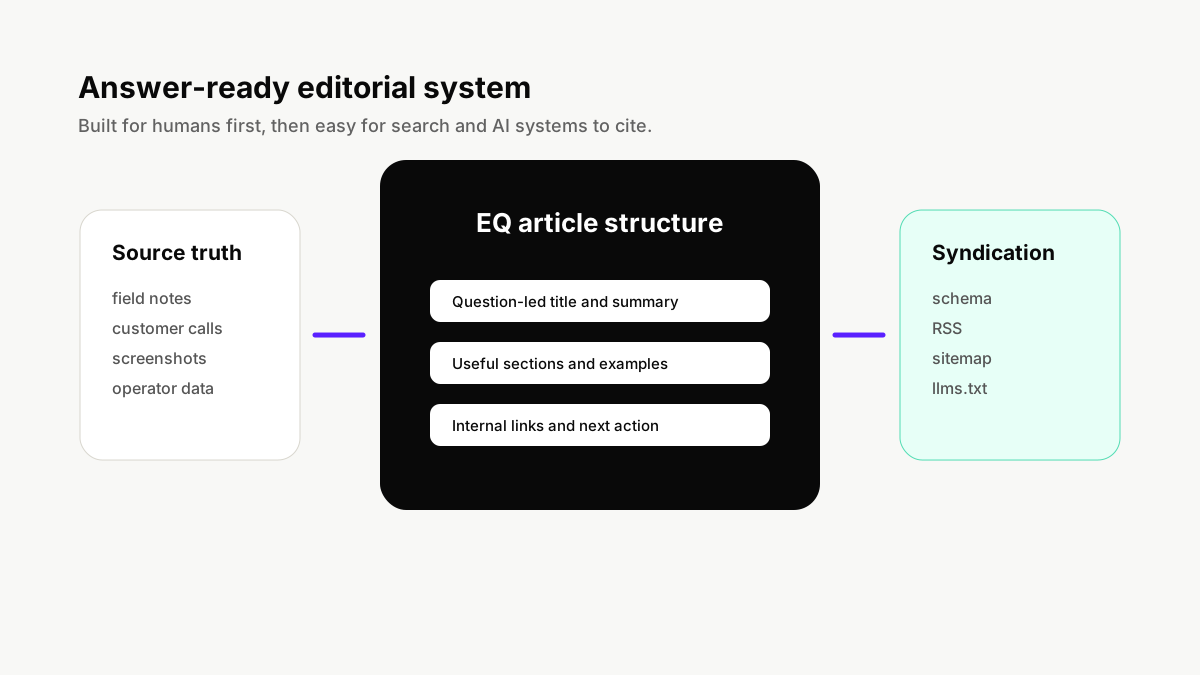
Step 3: Use an “answer page” template
Use this structure and keep it consistent:
- Direct answer (above the fold)
- Definitions of key terms (short)
- Typical ranges (and what shifts them)
- Example calculation (real numbers, simple math)
- Common pitfalls
- What we do in practice (your process)
- FAQ (3–7 short questions with direct answers)
- Next step CTA (benchmark, teardown, intake)
Step 4: Make it credible (this is the part most agencies miss)
Answer engines are cautious. They avoid reusing content that feels vague or salesy.
To make your answer page reusable, include at least two of:
- a specific range and what shifts the range
- an example scenario (industry, location, seniority, urgency)
- a simple comparison table
- a “last updated” note
- definitions that match standard usage
If you can cite one solid public reference (BLS, compliance guidance, credible benchmarks), do it. One good citation beats ten random links.
Step 5: Format for answers, not vibes
Make it easy to scan and parse:
- clear H2/H3 headings
- short paragraphs
- bullets for lists
- tables for comparisons
- consistent terminology across pages
Step 6: Link pages into a small knowledge base
Every answer page should link to 3–6 related pages.
Example: if you publish “Typical IT staffing markup,” link to:
- bill rate vs pay rate
- contract-to-hire conversion fees
- how time-to-fill varies by role
- contractor budgeting guide
This builds a dense cluster of staffing truth that both humans and machines can trust.
Step 7: Run a cadence and versioning
AEO rewards being current.
Pick a cadence you can maintain:
- Week 1–2: publish 10 answer pages
- Week 3–4: publish 10 more
- Monthly: refresh the 5 highest-traffic pages and update “last updated”
Your edge isn’t one perfect post. It’s becoming the most specific, reliable staffing reference in your niche over time.
Example: answering “What’s a normal staffing markup?”
Direct answer
A typical staffing markup often lands in the ~25%–60% range, but the “right” markup depends on role scarcity, compliance burden, and delivery speed. High-volume light industrial tends to compress margins, while specialized IT, healthcare, and cleared roles often support higher markups.
What changes the markup
- Skill scarcity (rarer roles carry more value)
- Speed requirements (urgent fills cost more)
- Compliance load (credentialing, background checks, onboarding)
- Guarantees and replacement terms (risk shifts price)
- Payment terms (net-60 is not net-15)
Simple example calculation
If pay rate is $60/hr and bill rate is $90/hr:
- gross spread = $30/hr
- markup on pay = $30 ÷ $60 = 50%
In practice you also factor burden, payroll taxes, benefits, and delivery cost.
The AEO checklist (print this)
- Pick 20 buyer questions tied to money
- One page per question
- Answer first (2–5 sentences)
- Define terms
- Include a range and what shifts it
- Add one example calculation
- Add a table where helpful
- Add 3–7 FAQs with direct answers
- Link to 3–6 related pages
- Add a “last updated” note
- Ship 20 pages in 30 days
FAQ
Does AEO replace SEO?
No. AEO is an extension of SEO that optimizes for answer reuse and citations, not just clicks.
Do we need schema markup?
Not to start. Clear structure and direct answers get you most of the win. Add schema later if you have bandwidth.
What should we publish first?
Pricing, time-to-fill, contract terms, and risk questions. These are high-intent topics that convert.
How do we measure AEO?
Track:
- Search Console impressions and engagement
- increases in branded search and direct traffic
- inbound leads referencing AI tools (“ChatGPT said…”) or quoting your ranges
- calls sourced from knowledge pages
Want the “20 questions” list for your niche?
If you share your niche (IT, healthcare, light industrial, exec search) and target geography, EQ can map the 20 highest-intent buyer questions and provide an AEO publishing plan.
Call to action: Book a 15-minute AEO teardown with EQ.app.