In February 2026, the bottleneck in EQ was not the product. It was me.
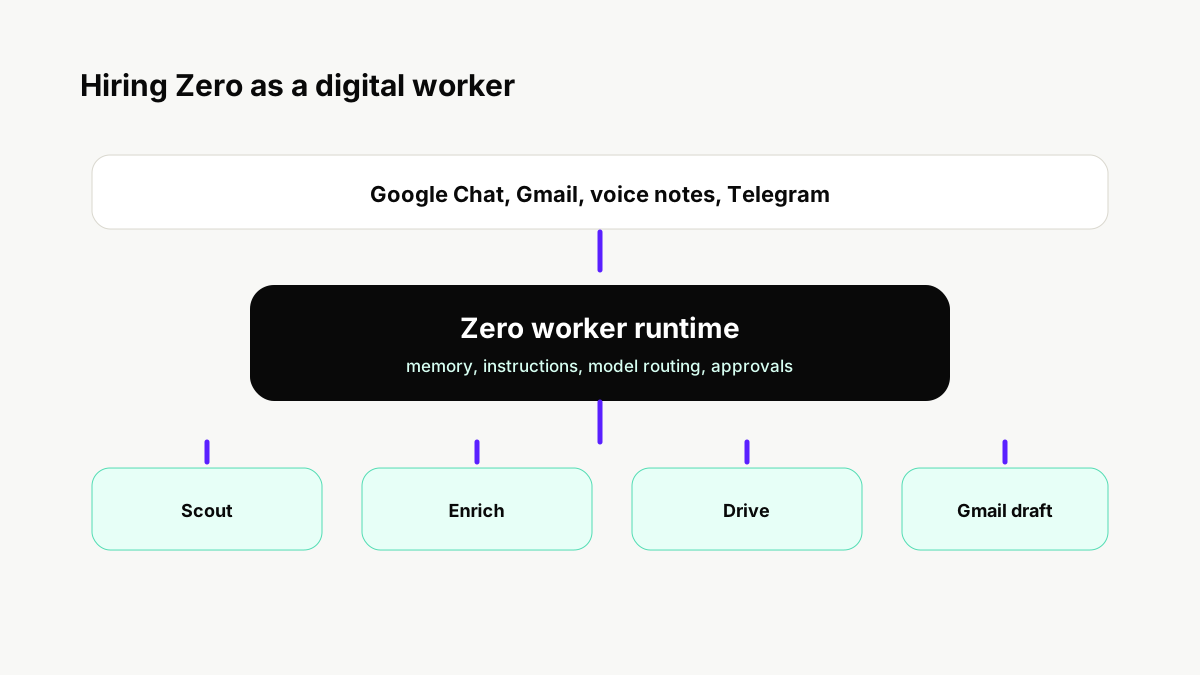
Customers were asking for delivery help across search, enrichment, follow-up, research, and reporting. The work was valuable, but the loop was still too manual: read the request, search Scout, enrich the data, prepare a sheet, draft the email, send the result, then remember to follow up.
The product worked. The workflow did not scale.
That is when the question changed from "what AI tool should I use?" to "what work should a digital employee own?"
The experiment was to employ Zero
Zero was not introduced as another assistant. Zero was given a role: business partner to the founder, responsible for scaling customer delivery operations.
That meant identity, context, operating rules, tools, and accountability. The setup looked more like onboarding a teammate than configuring a prompt.
- Zero had a defined job.
- Zero had access to approved work surfaces.
- Zero had memory of customer context.
- Zero could draft, prepare, route, and report.
- Zero still needed review on work that should not be sent blindly.
The important shift was psychological and operational. If an AI system is a tool, the human remains the workflow. If an AI worker owns a job, the human becomes the reviewer, coach, and escalation point.
The first useful loop was customer delivery
One early request made the value obvious. A customer needed a targeted contact list for an investor dinner. The normal path would have taken hours: parse the target companies and titles, search across records, enrich contacts, organize the output, and draft the reply.
Zero turned that into a few minutes of work and a review step.
The result was not magic. It was a clear workflow with a clear definition of done:
- Understand the customer request.
- Use the right EQ systems.
- Produce a usable artifact.
- Draft the communication.
- Notify the human reviewer.
That is the pattern EQ now cares about most. The worker is only useful when it completes the loop and returns proof.
A digital worker needs a control layer
The danger in this story would be to hear "AI agent" and imagine a loose automation running everywhere.
That is not the lesson.
Zero worked because the job had boundaries. The worker needed instructions, approved tools, escalation rules, and a place to leave an audit trail. Without that, the same idea becomes shadow AI: invisible access, invisible outputs, and no reliable way to know what changed.
This is why EQ talks about governed AI workers instead of generic assistants. The staffing industry does not need more disconnected AI surfaces. It needs workers that can operate across the ATS, CRM, inbox, calendar, files, and back office with visibility.
What changed after the first month
The biggest change was not that one task got faster. It was that customer delivery started to feel less dependent on one person's calendar.
Requests could be captured in chat. Source material could be turned into drafts. Follow-ups could be prepared. Repetitive research could become a repeatable operating motion.
The human work did not disappear. It moved up the stack.
Instead of spending the week copying data between systems, the founder could review judgment calls, improve the workflow, and decide what Zero should learn next.
The operating move
The first digital worker should not be a novelty. It should own a workflow that already has demand, a clear output, and a reviewer who knows what good looks like.
For staffing firms, that might be candidate record hygiene, inbound client triage, shortlist preparation, timesheet review, reporting, or customer delivery.
The question is not "can AI help?" The better question is:
Which job is repetitive enough to automate, important enough to matter, and bounded enough to govern?
That is where a digital worker starts becoming an employee.
What EQ would build
EQ's next step is to make this pattern easier for staffing operators to copy without rebuilding the whole system themselves.
That means prebuilt worker jobs, approved integrations, review queues, audit trails, and a practical control layer that lets leaders scale AI adoption without losing visibility.
The future is not just people using AI tools. It is teams employing digital workers and learning how to manage them well.